The Critical Date: The James Bay Cree v. Quebec (1995)
SOVEREIGN INJUSTICE: THE JAMES BAY CREE AND QUEBEC SEPARATION
In 1995, the Grand Council of Cree of Northern Quebec and James Bay published Sovereign Injustice: Forcible Inclusion of the James Bay Cree into a Sovereign Quebec in response to the Parti Québécois (PQ)’s contention that a separate Quebec would be entitled to accede to independence with its provincial boundaries intact (Lalonde, 2002). Sovereign Injustice was published in the years following ICJ rulings in the 1986 Frontier Dispute (Burkina Faso/Republic of Mali), the 1992 Land, Island, and Maritime Frontier Dispute (El Salvador/Honduras, Nicaragua Intervening), and the 1994 Territorial Dispute (Libya Arab Jamahiriya/Chad). The text took aim at the PQ’s use of the international legal doctrine of uti possidetis de jure to justify their position that Quebec’s international borders ought to be identical to the borders that it had as a Canadian province. The PQ’s vision for an independent Quebec included the traditional territories of the Cree and Inuit Peoples of Northern Quebec.
The PQ cited the 1986 Burkina Faso/Mali boundary case in which the ICJ stated that uti possidetis “is logically connected to the phenomenon of obtaining independence, wherever it occurs.” While the PQ recognized that Quebec was not decolonizing and that Canada was not a colonial power, it still held that uti possidetis could be extended to cover non-colonial contexts as had been the case in Yugoslavia and in the U.S.S.R. According to the PQ, Quebec was entitled to keep its present provincial borders not because it was a nation that consisted of a people, but because upon separation it would be a state.
The Grand Council of Cree rejected the PQ’s position and the argument that uti possidetis de jure was a universal, peremptory norm that could be applied unilaterally. The Grand Council of Cree countered the PQ by arguing that they are a self-determining People and they refuse to be “removed” or “transferred” from Canada without their consent. They are organized societies with their own political, social, and legal systems that exist independently of the Canadian, the Quebec, and the international state system. Their right to Eeyou Astchee territory (Northern Quebec) derives from the fact that they have occupied the territory since time immemorial. The Québécois claim, on the other hand, came at a much later date and largely as a result of Hydro-Quebec’s northern development schemes (Sanders, 1995).
PARTITIONING AND THE CRITICAL DATE
The PQ held that the critical date for the uti possidetis de jure border should be the day that the province (in theory) declared independence from Canada: October 31, 1995. Critics countered by saying that the date should be July 1, 1867, the day of Canadian Confederation, that is, the day that Quebec joined the federal system (Ratner, 1999). If Quebec seceded with the 1995 boundaries intact, the new Quebec state would include the Cree and Inuit lands of Northern Quebec. If Quebec seceded with the boundaries they had on July 1st, 1867, on the other hand, Quebec’s state territory would be substantially smaller than its 1995 provincial territory.
The Grand Council of Cree entered into the debate by publishing a map of Quebec that divided the province into three sections. The white section shows the Canadian provinces in 1867 at the time of Confederation. The green section shows Quebec’s first boundary extension, which the Canadian government undertook in 1898 to expand Quebec’s territory. The Canadian government again extended Quebec’s boundaries in 1912, which is represented by the section in yellow.
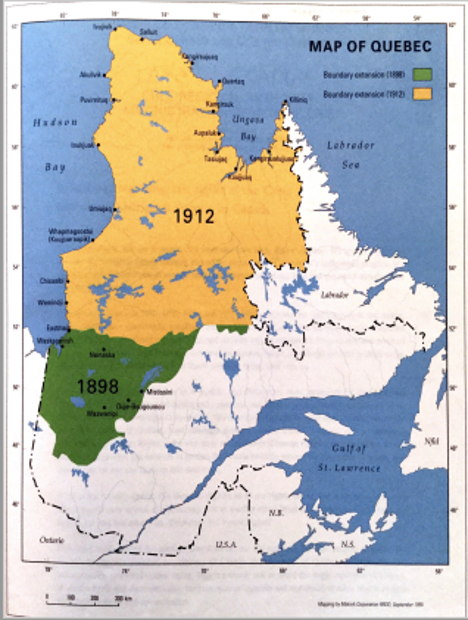
The map problematizes the PQ’s assumption that Quebec’s 1995 boundaries are not the only relevant borders. From the Cree perspective, the “critical date” of independence is an arbitrary construct.
. First, it makes the point that Quebec’s 1995 provincial boundaries are not the only relevant borders. Third, the map makes the argument that the Cree were “here first” through the use of indigenous place names. Fourth, the map also represents a historical grievance as it illustrates the spatial injustices associated with the 1898 and 1912 boundary extensions (Ramos, 2000, p. 105).
The Cree make two important points. First, that provincial boundaries need not automatically turn into international boundaries and, second, that the territorial rights of the Quebec settler-state do not take precedence over the rights of the James Bay Cree. The Cree peoples were the original inhabitants of northern Quebec and they have been inhabiting their lands since time immemorial.
the boundary extensions were unjust because they were undertaken without Cree consent.
The Cree map also represents a historical grievance (Ramos, 2000, p. 105). It illustrates the spatial injustices associated with the 1898 and 1912 boundary extensions in Quebec. The Cree peoples were the original inhabitants of northern Quebec and they have been inhabiting their lands since time immemorial; the boundary extensions were unjust because they were undertaken without Cree consent. While the boundary extension of 1912 contained guidelines for the relationship between Canada, Quebec, and the Cree tribes, at this time neither Quebec nor Canada has formal treaties with the indigenous peoples in the original southern parts of Quebec (Mohawk, Huron), or with those in the middle area that was added in 1898 (Montagnais, Naskapi), or with those in the north (Cree, Inuit, Innu) (Sanders, 1995). It wasn’t until the James Bay and Northern Quebec Agreement (JBNQA) of 1975 that the northern territories were transferred to Canada and treaty obligations were formalized (Radan, 2003). Thus, the Cree argued that if Quebec were to secede with its 1995 boundaries intact, the new Quebec state would include the Cree and Inuit lands of northern Quebec, and that would be an injustice, as these lands would be transferred to Quebec without Cree consent.
The green and yellow sections are marked with indigenous place names such as Whapmaagoostui, Inujuak, Tasiujaq.
